


February 2026
On the path to inclusive and future oriented organizations
#OrgoftheFuture
By Jocelina Ndimbalan
(Berlin, german-only)
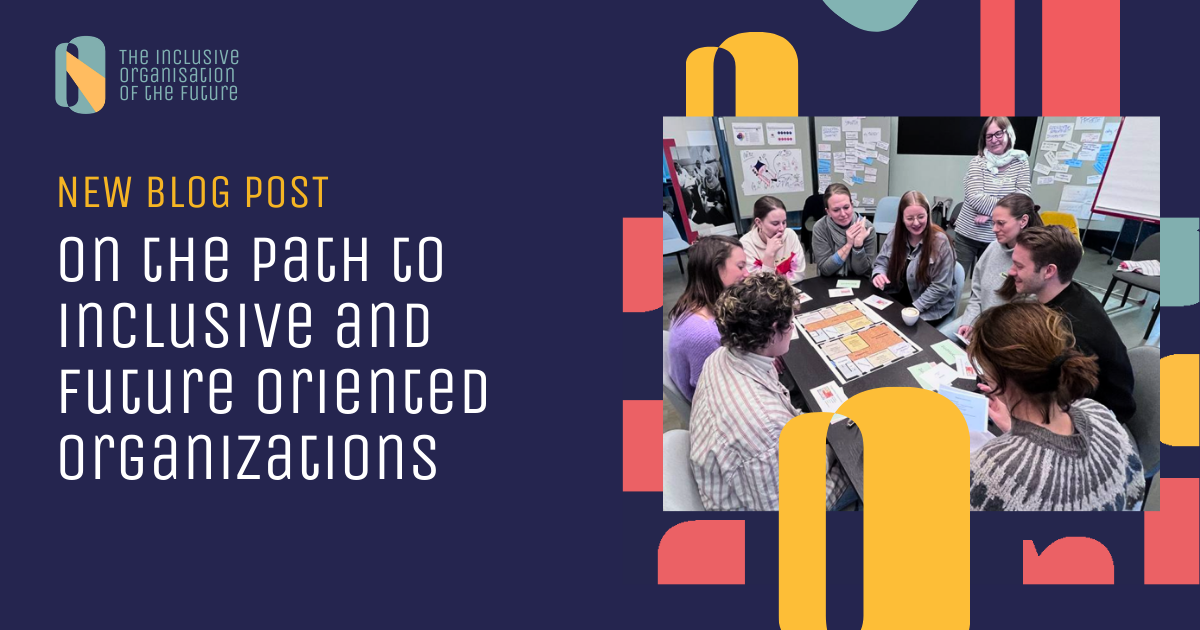
In 2025, twelve civil society organizations joined forces with us and our project partner emcra – Co‑Shaping Europe to embark on a journey to become an inclusive organization of the future. Organizational development is no small undertaking, but now that we are a third of the way through the project, we would like to take stock and look ahead to the next steps in 2026.
Last year, the first three of a total of six planned training modules took place, each accompanied by the DisCheck awareness team. FAIR SHARE was able to contribute its expertise in feminist leadership, power critique, and anti-discrimination in a targeted manner. But what exactly is an inclusive organization and what does it take to create one? We are convinced that this requires processes and structures that reflect values such as justice, care, trust, and anti-discrimination within organizations.
Together with experts Tara Hawk, Mashanti Alina Hodzode and Stephanie Cuff-Schöttle (DE_CONSTRUCT Lab) we introduced the participating CEO’s, People & Culture officers, as well as other colleagues who want to help shape and transform their organizations to key questions:
- How do I lead and how would I like to lead?
- Where and how does power manifest itself in our structures and our interactions?
- How are decisions made and communicated?
- What impact do current structures and processes have on people who are marginalized in multiple ways, and where does exclusion occur that we hardly notice?
We also addressed topics such as trust and security within the team, feedbackculture, and feminist conflict management. What we found was that if organizations do not actively embed and live these aspects in their work culture, their maintenance falls to individual people—a risk that can quickly lead to exhaustion.
This is also emphasized by experts Mashanti Alina Hodzode and Stephanie Cuff-Schöttle. They trained our participants on the topics of stress, resilience, and care. After all, workplaces and teams are one thing above all else: gatherings of people who are creating something new. However, employers must not neglect the well-being of their employees. The DE_CONSTRUCT team made it clear to us how important it is to deal with stress on an individual level, but that we also need spaces and methods to address this stress collectively. Establishing a discrimination-critical perspective on our togetherness is integral, and we must not forget to ask ourselves what it means for people who are marginalized in multiple ways.
The words of one of our project guides (who act as bridge builders between the project and the participating organizations) resonated for a long time: “There is no better time to think about processes and structures than now, while we are discussing our new statutes.” We share this assessment. Transformation processes can be both exciting and unsettling, but they always bring momentum with them.
In the project, we empower participants to recognize and seize opportunities and potential. To this end, we offer not only thematic dives, but also current models and practical concepts that organizations can use to analyze and further develop their own contexts. Our project partner emcra – Co-Shaping Europe contributes many years of experience in organizational development, innovative tools, and the principles of sociocracy.
Outlook: What’s in store for 2026?
-
At the same time, the peer learning groups “Organizational Development” and “Equity & Diversity” are being launched. There, participants can discuss cases they have brought with them and, above all, learn with and from each other.
-
Based on a status quo analysis, we’ll create customized workshop and coaching offerings that help organizations on their path to greater inclusivity.
-
At the end of April, the four-day methodology training course for “Open Space” facilitators will take place in Berlin, which is open to other representatives from civil society. More information and registration can be found here!
-
emcra – Co-Shaping Europe will lead the next three training modules and guide participants through the implementation of new structures and processes.
We can happily say our project organizations are on track, and we are convinced that only by working together— as a network— in cooperation can we leave traditional, patriarchal systems behind and create sustainable inclusive organizations.