

Shared Ground Collective

A space for racialised and gender-marginalised practitioners

A cross-organisational collective created to hold experience collectively, name structural patterns, and shift responsibility where it belongs – onto organisations, not individuals.
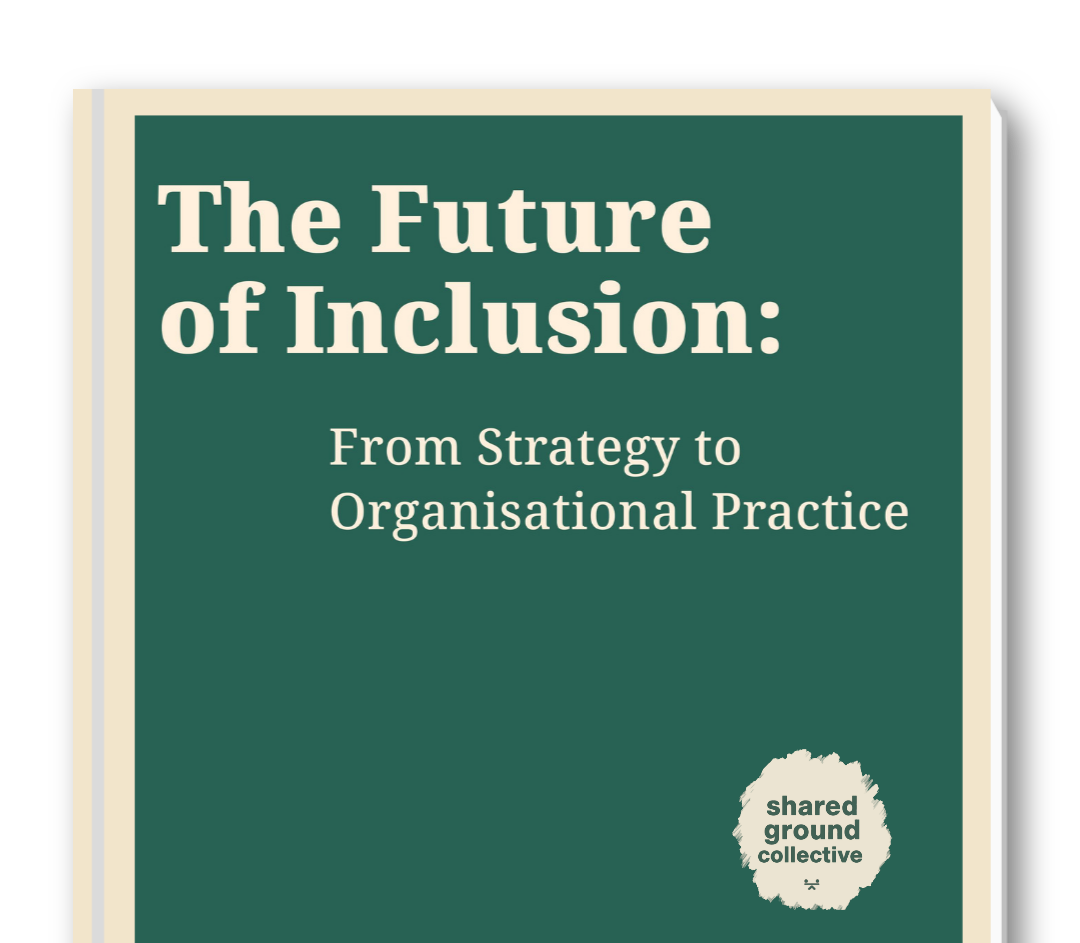
LEARNING BRIEF

Collective learning for
organisational accountability.

A cross-organisational collective created to hold experience collectively, name structural patterns, and shift responsibility where it belongs – onto organisations, not individuals.
UPCOMING SESSIONS

What’s coming up.

All sessions are online and open to Collective members. Sharing Spaces are capped at 15 participants for intentional intimacy.
MEMBERS ONLY 

Q2 Strategic Session

Our next Strategic Session on “Decolonising Professionalism Through Matriarchal Values”, with our guest speaker Dania Gharaibeh, Gender and inclusion expert.
Tuesday 9 June, 9:30 CEST | 10:30 AST | 9:30 CAT | 13:30 IST
MEMBERS ONLY

Monthly Sharing Space

A small, confidential, trauma-informed space for racialised and gender-marginalised civil society practitioners, facilitated by Hanieh Khosroshahi.
Thursday 25 June, time tbc
MEMBERS ONLY

Monthly Sharing Space

A small, confidential, trauma-informed space for racialised and gender-marginalised civil society practitioners, facilitated by Hanieh Khosroshahi.
Tuesday 21 July, time tbc
Sessions are open to members of the Collective. Not a member yet? The Collective is open to racialised and gender-marginalised practitioners working in international civil society. Join here →
WHY THIS EXISTS

Not an isolated case.
Not an individual problem.

Across international civil society and the NGO sector, many organisations speak the language of justice – while the people most impacted by racism and gender-based oppression are left to carry the cost inside their own workplaces.
Shared Ground Collective exists to change that starting point. It is a cross-organisational collective for racialised and gender-marginalised practitioners working in international civil society – creating protected spaces to connect, reflect, and build collective clarity about structural harm, beyond individual organisations.


It is a cross-organisational collective for racialised and gender-marginalised civil society practitioners, creating protected spaces to connect, reflect, and build collective clarity about structural harm, beyond individual organisations.

Why this collective

In many civil society and INGO organisations, experiences of racism and gender-based harm are treated as:
This framing obscures structural patterns and places responsibility on those most affected — racialised and gender-marginalised staff who are already navigating hostile conditions with limited institutional support.
  • individual issues
  • interpersonal conflict
  • or isolated incidents
Shared Ground Collective responds by creating cross-organisational infrastructure where experiences can be held collectively, patterns can be named, and responsibility can be reframed as organisational, not individual.

“An organisation is only as strong as its most vulnerable staff members.”

“True inclusion focuses on participation and power, not only presence.”

– Ama Afrifa-Tchie, Q1 2026 Strategic Session
Logo for the FAIR SHARE project Shared Ground Collective: the words ‘shared ground collective’ in dark green, set in lowercase on a light, organic brush-stroke shape against a black background, with a small abstract symbol beneath the text.
UPCOMING SESSIONS

Two complementary
spaces, one collective.

The Collective is built around two distinct but connected spaces, one centred on care and processing, one on learning and organisational strategy.

Sharing Spaces

COLLECTIVE PROCESSING & CARE – MONTHLY

Sharing Spaces are confidential and non-extractive. They are not designed to produce outputs, they exist to sustain practitioners.

Small, protected monthly online gatherings (max. 15 participants), facilitated by a trauma-informed somatic practitioner experienced in navigating racialised and gender-based power dynamics in civil society.

These sessions centre:

– collective processing of lived realities
– somatic and body-based grounding practices
– reducing isolation through shared presence
Sharing Spaces

LEARNING & ORGANISATIONAL CLARITY 6 QUARTERLY

1.5-hour topic-based sessions focused on workplace dynamics in international civil society through an anti-racism and gender justice lens. Each session is accompanied by a freely available learning brief — a public inclusion resource synthesising expert input and practitioner experience.

  • Input from an external speaker or experienced practitioner
  • Facilitated collective discussion on organisational practices
  • Reflection on what structural shifts are possible
  • Followed by a public learning brief (free, CC licensed)


ORIGIN

Who is behind
Shared Ground

Shared Ground Collective emerged from a closed session held at the FAIR SHARE Festival in May 2024 – co-conceptualised and co-facilitated by Ama Afrifa-Tchie, Global DEI Lead at the Norwegian Refugee Council, and Ariane Alam of the FAIR SHARE team.
 
In the year that followed, interested civil society practitioners met multiple times to share their experiences, feedback, and needs. Their input was instrumental in shaping the design, structure, and priorities of what is now Shared Ground Collective.
 
We extend our sincere thanks to Ama Afrifa-Tchie for co-conceptualising and co-facilitating the initial space, and to all practitioners who contributed their time, insight, and care.

Shared Ground Collective is supported by the German Postcode Lottery.

We are deeply grateful for their trust in this work and for making this pilot year possible.

Stay connected 

If you have questions about the project or would like to get involved, feel free to contact us via the form below or email shared-ground@fairsharewl.org.

13 + 15 =

A hand-drawn illustration of a network: colourful circular nodes connected by thick, red, brushstroke-like lines on a light blue background. The nodes vary in colour — including black, yellow, green, orange, teal, purple, grey, and white — and are linked in a dense web, suggesting connection, collaboration, or an ecosystem.